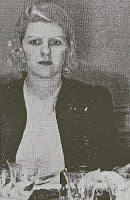
Bluebell was contracted by Scottish dance company manager Alfred Jackson to dance in Berlin in the late 1920s. In the summer of 1930 and again in 1931, Jackson asked her to go as a holiday replacement to the Folies Bergères in Paris (rue Bergère, 9th arrondissement). While in Paris, Bluebell was offered a job at the Casino de Paris in the rue de Clichy (9th arrondissement) by Alfred Jackson’s brother, John William, but she soon left and returned to the Folies Bergeres as ‘captain’ of her own dance group, the Bluebell Girls. In March 1939, at Trinité church (place de la Trinité, 9th arrondissement) Bluebell married a stateless Jew of Romanian origin called Marcel Leibovici, who led the house orchestra at the Folies Bergères. They lived close by, at 83, rue Blanche (9th arrondissement), overlooking the Moulin Rouge.
With the German army fast approaching, Marcel and Bluebell joined the exodus from Paris to Bordeaux in June 1940, but they returned to Paris when they failed to secure a passage to the UK. On December 1, 1940, the French police came looking for Bluebell at her flat in rue Blanche. It was ordained that, as a British passport holder, she should be sent to an internment camp in Besançon, even though she was pregnant. However, she was released on New Year’s Eve 1940 after Count O’Kelly de Gallagh of the Irish Legation took up her case and convinced the authorities that Bluebell was Irish and thus a neutral. For much of the Occupation, Bluebell produced a show in the Chantilly, a small cabaret at 10, rue Fontaine (now Théâtre de la Fontaine, 9th arrondissement) but she refused an offer to perform in Germany. In early 1942, Marcel was rounded up in Marseille and sent to Gurs internment camp in the south of France. When he escaped, he made his way back to Paris. For the next two and a half years, Marcel had to remain hidden, first in a top-floor attic at 37, rue de la Bûcherie (5th), very close to the Prefecture of Police, and then, when he felt the authorities were closing in, at an address in rue Berthollet (5th arrondissement). During this time, Bluebell managed to keep her husband fed and clothed, and also managed to become pregnant—twice. In June 1943, she was hauled before the Gestapo who were looking for her husband, but she managed to survive the ordeal without giving away the secret of Marcel's whereabouts. She later learned that the concierge in the building where her husband was hiding had betrayed several other residents. Only the 60 francs a week and the eggs and milk she received regularly from Bluebell stopped her from doing the same with Marcel. But one day a Jewess who claimed be "a daughter of Marcel’s aunt" was arrested in the street by plainclothes policemen while walking with Bluebell. The story of theatre owners Marion and Lucas Steiner in the classic François Truffaut film, Le Dernier Métro, was inspired by the real-life experiences of Bluebell and her husband during the war.
In 1972, Bluebell moved to a penthouse apartment in a newly-built block in rue de la Faisanderie (16th arrondissement). She died in August 2004 and lies buried in Montmartre cemetery, right beside the writers and critics Edmond and Jules de Goncourt who gave their name to the 'Prix Goncourt', the most prestigious literary prize in the French language. ------------ Select Bibliography Bluebell: The Authorised Biography of Margaret Kelly, Founder of the Legendary Bluebell Girls (1986) George C. Perry Obituaries in: The Daily Telegraph, Sept. 15, 2004 The Stage, Sept. 19, 2004 |